









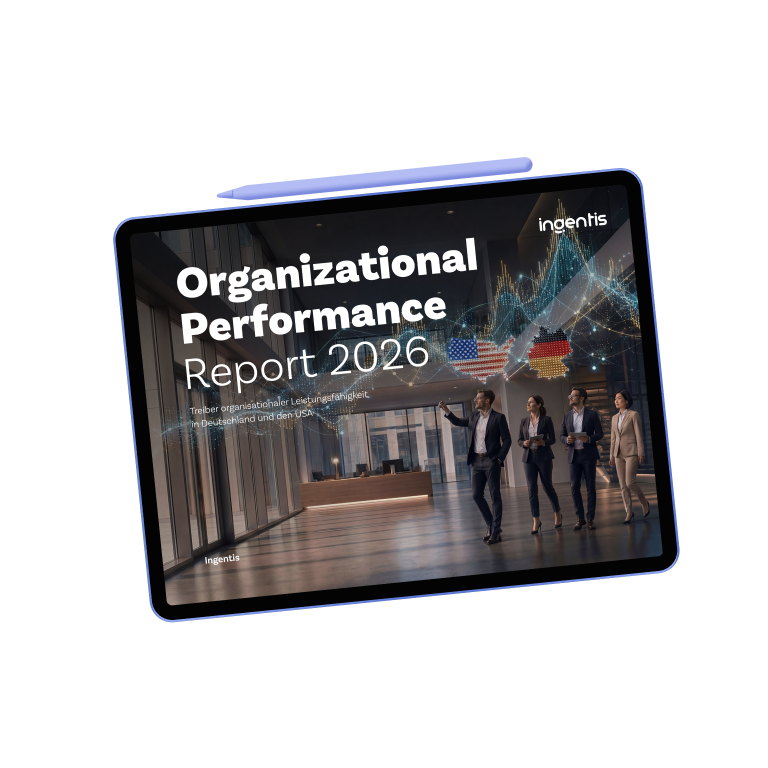
Organizational Performance Report 2026

What Truly Makes Organizations High-Performing

New study with over 1,200 respondents in Germany and the USA: how companies are positioned today and why many are failing to realize their full potential.

Logo Volkswagen GroupLogo Versicherungskammer BayernLogo Stadtwerke DüsseldorfLogo Rewe GroupLogo Neptune EnergyLogo NBCU CareersLogo MerckLogo HeraeusLogo Häcker KüchenLogo EdekaLogo EchoStar

Organizational Performance Is Not a Soft Topic – It’s Your Strongest Lever

Many companies invest in talent, technology, and processes while overlooking the most critical factor: the organization itself. Yet our Organizational Performance Report 2026 clearly shows that structures, transparency, and data-driven decisions have a measurable impact on productivity, innovation, and business success.

Together with Prof. Dr. Stephan Fischer, Director of the Institute for Human Resource Research at Pforzheim University, we conducted the first systematic study examining what truly makes organizations high-performing and where companies stand today. The study is based on a large-scale survey of more than 1,200 employees in Germany and the USA, including numerous leaders from large organizations. The findings reveal significant differences between the two countries and, above all, one thing: enormous untapped potential for greater organizational performance.

When we constantly complain that transformation in Germany is progressing only slowly, this study finding certainly helps explain why: German companies are comparatively inflexible in the way they are structured. In addition, they are not making sufficient use of the opportunities to change this based on their existing data and the use of appropriate visualization and analytics tools.
Joachim Rotzinger, CEO / /Ingentis

German Companies Are Leaving Organizational Potential Untapped

For the first time, a direct comparison between Germany and the USA reveals how effectively companies are truly leveraging their organizational performance potential.

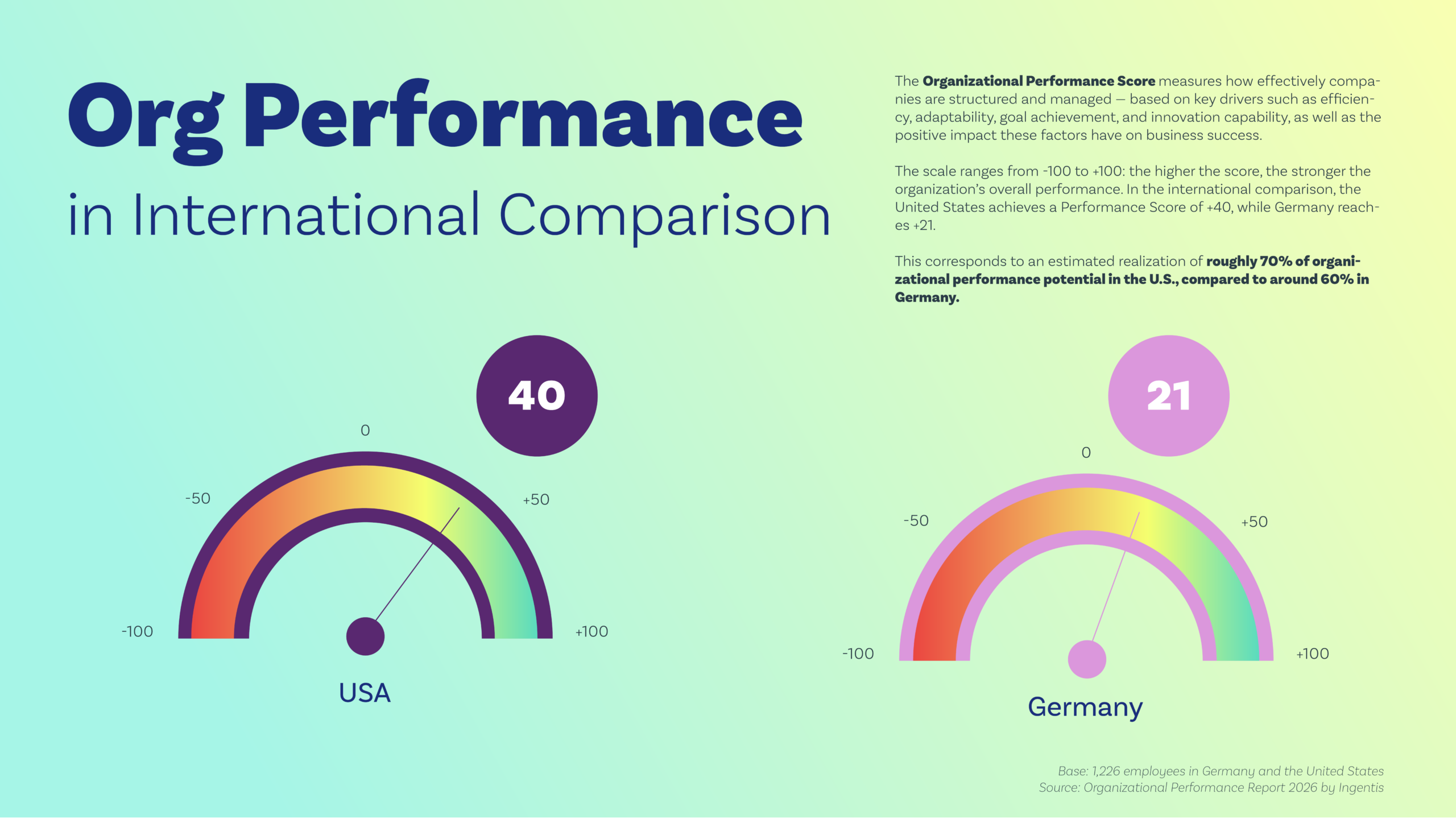
The result: U.S. companies achieve a score of 40 points in the Organizational Performance Score, while German companies reach only 21 points. Behind these figures lies a significant difference in organizational performance: according to the study, U.S. companies already leverage around 70% of their potential, whereas German companies reach only about 60%.

The reasons for this include lower adaptability, weaker reorganization capabilities, and a significantly less consistent use of data for organizational decision-making.

Organization Influences Performance

Key Findings at a Glance

Effective Organization Creates Competitive Advantage

Companies with high organizational performance are more innovative, productive, and successful. This performance is driven primarily by adaptability, clarity of goals, and exploration in how organizations are structured, while efficiency plays a supporting role. What theory has long suggested can now be statistically confirmed through our cross-country study.

Germany Is Failing to Fully Leverage Its Potential

Yet, according to respondents, a great deal of potential remains untapped: while U.S. companies leverage around 70% of their performance potential, Germany reaches only about 60%. Behind this also lies a management issue. While German companies tend to operate with a focus on security, planning, and documentation, U.S. companies are more strongly driven by a mindset of shaping, steering, and embracing change.

Reorganizations Are Frequent but Rarely Successful

Three out of four respondents report having experienced reorganizations within the past five years. Every second person believes further transformation is necessary to achieve future goals. Yet Germany struggles in this area: only around 17% of respondents say the reorganization was successful, and 48% describe it as slow and exhausting. In the U.S., both aspects are viewed far more positively.

Lack of Transparency Limits Development Opportunities

Four out of ten respondents say that employee potential is not being fully realized. In Germany, only around one in three people also report having clarity about who is responsible for what. One reason lies in the use of data: every third respondent considers working with data to be too time-consuming, while its value for quantitative and qualitative workforce planning is underestimated. Respondents in the U.S. value and use visualizations far more intensively than respondents in Germany.

Who Is This Report Most Relevant For?

  • CHROs and HR leaders who want to actively shape organizational performance
  • Executives and top management looking to use the organization as a strategic lever
  • Leaders of organizational development and transformation who want to evolve structures effectively
  • HR business partners and workforce planners driving data-based decision-making
Clemens Siegfanz SAP

Request the Organizational Performance Report 2026 free of charge now!

Exclusive study results at a glance | Practical insights for better organizational decision-making | Actionable ideas to drive greater organizational performance