15. January 2026 12 minutes reading time

From Risk to Readiness: Why the Lack of Succession Planning Is a Strategic Threat

And how to move from static succession charts to continuous organizational readiness.

  1. Home
  2. Blog
  3. From Risk to Readiness: Why the Lack of Succession Planning Is a Strategic Threat

Key Takeaways

  • Unplanned leadership exits create immediate business risk – not just HR headaches.
  • Static succession charts and outdated spreadsheets fail the moment reality changes.
  • Continuous succession readiness gives you ongoing visibility into critical roles and successors.
  • With Ingentis org.manager, leadership teams can see structural risk, model scenarios, and act before gaps become crises.

    Leadership transitions are rarely predictable, but their impact always is.

    A CFO leaving mid-budget cycle or a high-performing GM taking a competitor’s offer can disrupt entire business units overnight. When organizations rely on static succession charts or scattered spreadsheets, they’re left reacting instead of deciding. That’s not an HR problem. It’s a succession planning risk. Succession planning deserves the same rigor as financial forecasting or supply chain resilience. The real question isn’t “Do we have a plan?” – it’s “Are we ready?”

    Succession planning is more than an HR formality

    ... it’s a business continuity imperative. For a full overview of the principles, tools, and process, see our knowledgebase article.

    Why Organizations Are More Vulnerable Than They Think

    Many leadership teams assume that having names on a succession chart equals preparedness. But static plans quickly become irrelevant. Roles evolve, people leave, priorities shift. By the time the chart is needed, it’s often out of date. This is especially risky in critical leadership or expert roles where a single point of failure can disrupt entire business units.

    Recent market research shows that 55% of organizations have experienced leadership gaps due to unplanned departures – clear proof of widespread succession planning risks. Yet only 33% feel prepared for transitions. In addition, 40% say their succession efforts are hindered by a lack of data or analytics. This highlights how difficult it is for organizations to maintain real visibility into succession readiness. [Source: Gitnux 2025]

    55% of organizations have experienced leadership gaps due to unplanned departures. Yet only 33% feel prepared for transitions.
    Gitnux Succession Planning Statistics / /2025

    While confronting these visibility gaps, it’s easy to aspire to broad, fully skills-based visibility—where every role, requirement, and capability is mapped and dynamically connected. The idea is appealing, but still far from achievable at scale in most organizations. Fragmented systems, inconsistent skill definitions, and the realities of data governance and privacy mean that this kind of visibility is rarely comprehensive or reliable enough to support day-to-day decisions today.

    This is why most organizations continue to rely on a more focused and proven approach: targeted succession planning for key positions where continuity is truly business-critical. It’s practical, achievable, and aligned with how organizations actually operate.

    The goal is not to track every role in the organization, but to concentrate on the positions where disruption would materially impact performance, customers, or regulatory obligations. And even for these roles, static, one-time planning isn’t enough on its own.


    The Shift to Continuous Succession Readiness

    Given the level of exposure and the limits of traditional, chart-based planning, organizations are rethinking how they approach succession.

    In many organizations, succession planning still happens once a year, if at all. But leadership turnover doesn’t follow an annual schedule, and the risk of no succession planning is most visible when leadership changes happen outside the cycle. A key executive’s departure, an unexpected promotion, or a shift in business strategy can instantly render a static plan obsolete.

    That’s why a growing number of organizations are adopting a model of continuous succession readiness. It’s not about tracking every role; it’s about having ongoing visibility into your most critical positions and the people who could step into them. Succession planning becomes a dynamic capability, not a one-off event. And that shift from episodic planning to real-time preparedness makes all the difference in how resilient an organization truly is. Doing this well depends on realistic, data-driven insight into your structure and leadership bench.

    This shift from static plans to continuous readiness is only sustainable when it is grounded in realistic, data-driven insight into the current state of the organization.

    Continuous succession readiness

    Treated as an ongoing capability, not a tick-the-box process
    Focuses on critical roles where disruption would materially impact the business
    Uses current org data, risk indicators, and clear visibility into successors
    Updates as people move, structures shift, and strategies evolve
    Supports proactive scenario modeling before gaps turn into crises

    Static succession plan

    Built as a one-time exercise, often annually
    Focuses on replacement names rather than structural risk
    Relies on static org charts and spreadsheets
    Becomes outdated as soon as roles, people, or priorities change
    Used reactively when a vacancy appears

    Data-Driven, But Realistic: What Effective Succession Planning Looks Like Today

    Effective succession planning starts with making the current state visible and measurable. Succession readiness gains real value when organizations can connect their decisions to a clear view of structural realities.

    The point isn’t flashy dashboards or AI promises. Effective succession planning operationalizes a state of readiness.

    01

    It begins with

    understanding the structural realities of your leadership bench

    • Who’s nearing retirement?
    • Who’s managing an unsustainable span of control?
    • Where are the real gaps in bench strength?

    02

    Effective succession planning is

    operationalizing readiness by consistently surfacing

    • Where are we exposed?
    • Who could step up?
    • What would it take to get them ready?

    03

    Ingentis org.manager makes this practical by

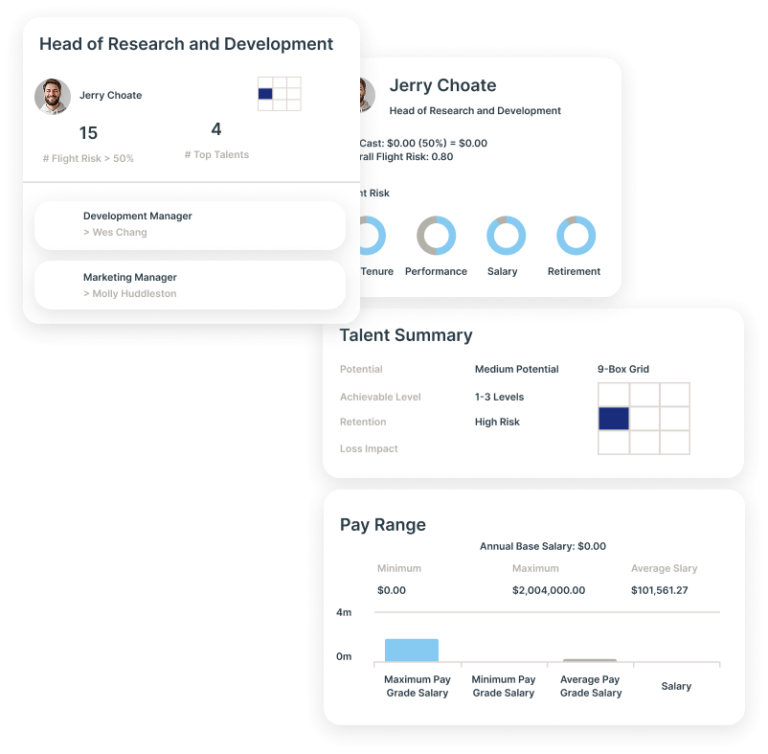
    visualizing key metrics across the org

    • tenure and age,
    • span of control and time in role,
    • HR indicators for readiness, retirement risk,
    • internal pipeline strength.

    This kind of visibility also supports a practical succession planning risk assessment, enabling HR and leadership to proactively spot vulnerabilities. Once you have clarity, you can go a step further and link insights to modeled options. Good analytics don’t add complexity. They add focus.

    Following the principle of Harmonize. Visualize. Analyze. Optimize. , org.manager helps organizations transform static data into dynamic insights and org design simulations that guide better leadership decisions without overengineering the process. From there, scenario modeling becomes the natural next step.

    Scenario Modeling: The C-Suite Advantage

    Simulation is where good succession planning becomes strategic succession readiness. It builds on analytics by bridging the gap between knowing your risks and understanding the impact of different responses.

    Even with solid analytics, leadership transitions raise structural questions: What happens if we merge these two departments? Who steps up if an executive exits tomorrow? How would a shift in reporting lines affect performance or cost?

    A critical difference between companies that manage succession well and those that don’t is the understanding that succession is a process, not an event.
    Joseph L. Bower / Donald K. David Professor of Business Administration, Emeritus / /Harvard Business School

    This is where org design and scenario modeling become a strategic advantage. With simulation tools like those in Ingentis org.manager’s OrgDesigner Extension, HR and business leaders can test structural changes before they’re implemented. Whether it’s backfilling a vacant role, modeling the exit of a VP, or evaluating a cross-functional reorganization, drag-and-drop modeling makes the impact immediately visible – on finances, structure, and operations.

    For the C-suite, this turns succession planning into strategic foresight. Instead of reactive firefighting, leadership teams gain the ability to explore options, weigh trade-offs, and make confident decisions grounded in data. It’s not about predicting the future, it’s about preparing for multiple versions of it.

    The ROI of Strategic, Continuous Succession Readiness

    Succession planning isn’t just a contingency, it’s a competitive edge. Organizations that invest in continuous readiness aren’t just avoiding disruption. They are building resilience, retaining high-potential talent, and navigating change with greater confidence.

    Even back in 2021, Harvard Business Review warned that poor succession planning isn’t a marginal HR oversight — it’s a major corporate liability. According to “The High Cost of Poor Succession Planning,” badly managed CEO and C‑suite transitions among large U.S. companies may destroy up to USD 1 trillion in market value annually. [Source: Harvard Business Review 2021]

    And according to a 2025 market analysis by Gitnux, 82% of companies with strong succession plans report revenue growth compared to those without one, underlining the business case for getting this right. [Source: Gitnux  2025]

    Taken together, these findings point in the same direction — succession readiness pays off and the impact is felt across the organization:

    • the C-suite gains confidence in leadership continuity,
    • team leads avoid stalled momentum during transitions, and
    • promising talent sees a future worth staying for.

    Succession readiness isn’t a behind-the-scenes HR initiative. It’s a practical, strategic capability that keeps teams out of limbo and the business moving.

    Turning that potential into reality requires a platform that makes readiness visible, actionable, and sustainable over time. This is where Ingentis org.manager provides a practical way to operationalize continuous succession readiness.

    How Ingentis org.manager Supports Executive-Level Succession Planning

    Ingentis org.manager helps leadership teams turn static HR data into continuous, scenario-ready insight into their leadership structure. It combines powerful visualizations, analytics, and simulation with up-to-date HR data. This equips decision-makers with the clarity they need to act quickly, close gaps, and design succession scenarios before disruptions hit.

    From a single platform, leadership teams can:

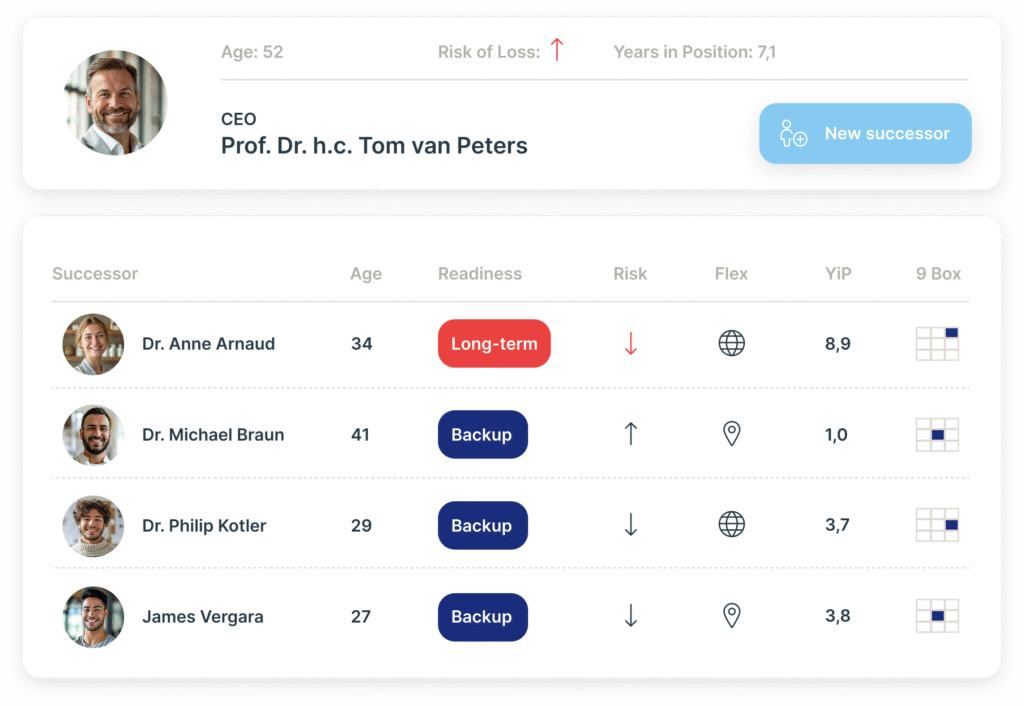
    1. Visualizeorganizational risk, bench strength, and internal successor pipelines.
    2. Analyze metrics like tenure, span of control, flight risk and retirement eligibility across org structures.
    3. Identifyvulnerable roles and model succession scenarios with financial and structural impact.
    4. Simulatemultiple what-if scenarios for leadership transitions and structural changes—before committing to them.

    Rather than chasing speculative forecasts, org.manager supports succession planning with grounded, structural insight. It enhances executive decision-making by providing clarity. Leaders get consistently refreshed views into organizational health that are contextual, actionable, and easy to trust.

    To dive deeper into how organizational structure influences agility, leadership resilience, and long-term success, explore our Organizational Design Whitepaper.

    You can’t predict every leadership change.
    But you can be ready for all of them.

    Explore how org.manager enables dynamic, data-driven succession planning in practice:
    Ingentis Use Case Succession Planning

    Conclusion: Succession Readiness Is a Continuous Capability

    Succession planning isn’t about filling a chart, it’s about building confidence. Confidence that your organization can absorb change, elevate the right talent, and move forward without hesitation. That kind of readiness isn’t achieved once—it’s maintained continuously.

    With Ingentis org.manager, leadership teams gain the visibility, analytics, and robust simulation power to make succession planning a strategic strength, not a reactive scramble.

    Ready to turn succession readiness into action?

    Take a look at our ready-to-run Succession Planning solution to see how it makes continuous readiness practical and visual.

    Ingentis Extension Succession Planning

    The latest posts by Ingentis

    18. December 2025 8 minutes reading time
    Happy,Busy,Executive,People,Working,Together,In,Office.,Female,Manager
    Five Levers for a Successful Reorganization
    A reorganization is more than just moving boxes around in the organizational chart. It affects …
    18. November 2025 10 minutes reading time
    Practical Applications of Ingentis org.manager
    In a world shaped by constant change, every phase of an organization’s lifecycle requires a …
    18. November 2025 7 minutes reading time
    Effectiveness along the corporate life cycle
    Organizational Effectiveness
    Organizational effectiveness goes far beyond simply increasing efficiency and pursues a holistic …