23. June 2026 7 minutes reading time

Holding Company Org Chart

A holding company structure consisting of a parent company and several subsidiaries.
  1. Home
  2. Knowledge Base
  3. Holding Company Org Chart

Key Takeaways

  • A holding company org chart visualizes ownership structures and legally independent entities within a corporate group.
  • It focuses on shareholdings, ownership percentages, governance and control mechanisms.
  • In multi-tier or international structures, transparency is critical for management, compliance and investors.
  • Digital org chart solutions help keep complex structures accurate, dynamic and strategically usable.

    Running or managing a holding company means operating within a network of subsidiaries, ownership interests and decision-making structures. Without clear visualization, strategic diversity can quickly turn into structural complexity. A professional holding company org chart brings transparency to corporate group structures and makes visible how ownership, governance and control interact.

    What Is a Holding Company Org Chart?

    A holding company org chart is a structured visual representation of the ownership and governance framework within a corporate group. Unlike a traditional organizational chart that shows reporting lines within one company, a holding company org chart focuses on legally separate entities and their ownership relationships.

    The emphasis is not only on hierarchy but on equity relationships. A well-designed holding company org chart clearly shows:

    • which entities belong to the group,
    • the percentage of ownership in each subsidiary,
    • how governance and control structures are organized.

    In growing corporate groups, structural depth increases quickly. Without a clear visual framework, understanding ownership chains and influence becomes difficult. The org chart therefore becomes more than a diagram — it is a strategic transparency tool. At the same time, it is closely connected to the overarching organizational structure, since ownership logic and actual governance models are inherently intertwined. The holding company org chart thus becomes an instrument that creates clarity and supports strategic steering.

    Understanding the Structure of a Holding Company

    A holding company primarily exists to own shares in other companies. Depending on its structure, it may exert strategic, financial or operational control. Common forms include:

    • Financial holding company, focused on asset management
    • Management holding company, actively steering subsidiaries
    • Operating holding company, combining ownership and operational business

    Each type influences how the org chart should be designed. A purely financial holding company may require a more ownership-focused chart, while a management holding must also reflect governance lines and steering mechanisms.

    It is important to note that each subsidiary remains a legally independent entity. Even with 100% ownership, subsidiaries have their own management and corporate bodies. A professional holding company org chart clearly reflects this legal separation.

    How to Structure a Holding Company Org Chart

    Typically, the parent company appears at the top of the chart, followed by subsidiaries on lower levels. Additional tiers may represent sub-subsidiaries or joint ventures.

    A structured holding company org chart usually reflects three dimensions:

    1. Ownership level – Who owns which percentage?
    2. Legal structure – What legal entity type is involved (LLC, Inc., Ltd., etc.)?
    3. Governance level – Who manages and controls each entity?

    For simple structures, a hierarchical layout is sufficient. For more complex corporate groups — especially those operating internationally — ownership percentages and multi-level chains must be clearly displayed.

    In addition, the functional dimension becomes increasingly important. Many holding companies centralize key functions such as finance, HR or IT at the parent level. In such cases, the org chart should not only reflect ownership structures but also visualize steering or service relationships. Clearly defined HR processes ensure smooth coordination between the holding company and its subsidiaries, making responsibilities transparent and traceable. A clear structure also provides the foundation for reliable decision-making in workforce management.


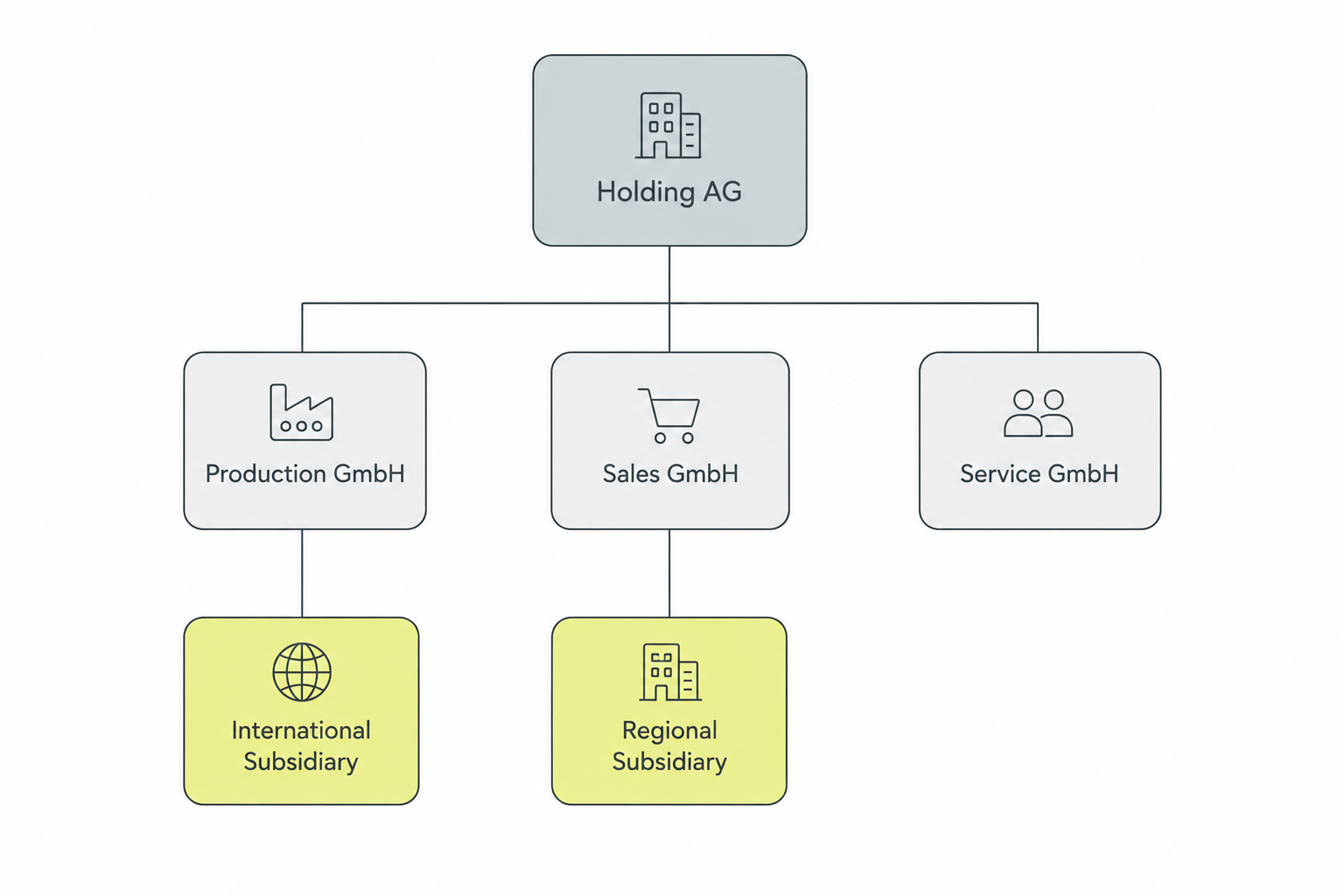
    Organizational chart of a holding company with several subsidiaries and equity investments.

    Example of a Multi-Tier Holding Structure

    Imagine a holding company overseeing several operating subsidiaries in different business segments. One manufacturing subsidiary holds a majority stake in an international entity. Additionally, a shared services company provides group-wide administrative support.

    At first glance, this structure may seem straightforward. However, once indirect shareholdings, minority stakes or cross-border legal entities are added, complexity increases significantly. A professional holding company org chart should therefore:

    clearly indicate ownership percentages,distinguish legal entities,identify international subsidiaries,visualize governance structures.

    During investor meetings, financing negotiations or due diligence processes, the clarity of such a chart becomes essential. An outdated or unclear org chart can quickly undermine confidence. At the same time, internal structural transparency is closely linked to the span of control and professional succession planning across the group.

    Typical Challenges in Holding Company Org Charts

    As corporate groups grow, structures evolve. Companies are acquired, sold or merged. Ownership stakes shift, and new markets are entered.

    Common challenges include:

    • multi-layer ownership chains,
    • international legal frameworks,
    • overlapping ownership and operational control structures,
    • frequent structural changes through M&A activity.

    Particularly during restructuring phases, the importance of an accurate and up-to-date structural visualization becomes evident. A static org chart quickly becomes outdated in such environments. Moreover, mixing operational reporting lines with legal ownership without clear distinction can lead to misunderstandings about actual control.

    More about this topic

    Restructuring Businesses

    This article explores key aspects of corporate restructuring – from the process and planning to actionable measures that can be taken.

    Strategic Importance for Governance and Control

    A professionally designed holding company org chart serves far more than documentation purposes. It enhances structural transparency across the corporate group. Clear visibility into ownership chains and governance arrangements reduces complexity and supports informed strategic decisions. From a compliance and risk management perspective, understanding capital flows, control mechanisms and decision rights is essential.

    In this sense, the holding company org chart is not merely a graphic representation. It forms part of the structural backbone of the corporate group and contributes directly to governance effectiveness.

    Conclusion: Transparency as a Competitive Advantage

    A holding company org chart goes far beyond a simple hierarchy diagram. It visualizes ownership relationships, governance structures and control mechanisms within a corporate group. Especially in multi-tier or international environments, clear visualization becomes a strategic necessity. Organizations that maintain transparent and up-to-date structures strengthen trust among investors, management and stakeholders. As complexity grows, digital and data-driven solutions become increasingly important. A well-designed holding company org chart is therefore not just a chart, it is a key instrument of effective corporate governance.

    FAQ

    Free Whitepaper

    Increase organizational effectiveness!

    Rising complexity, growing demands, increasing competitive pressure? Learn in our free white paper how your organization can be set up to be efficient, agile, and resilient.

    Organizational Effectiveness

    The latest posts by Ingentis

    29. April 2026 4 minutes reading time
    From AI adoption to AI readiness
    Generative AI has moved from experiment to expectation in HR with remarkable speed. In people …
    13. February 2026 12 minutes reading time
    Organization chart
    From Risk to Readiness: Why the Lack of Succession Planning Is a Strategic Threat
    A CFO leaving mid-budget cycle or a high-performing GM taking a competitor’s offer can disrupt …
    05. May 2026 8 minutes reading time
    Happy,Busy,Executive,People,Working,Together,In,Office.,Female,Manager
    Five Levers for a Successful Reorganization
    A reorganization is more than just moving boxes around in the organizational chart. It affects …