23. June 2026 12 minutes reading time

Work Overload: Signs, Causes and What to Do About It

Arbeitsüberlastung
  1. Home
  2. Knowledge Base
  3. Work Overload: Signs, Causes and What to Do About It

Key Takeaways

  • Work overload happens when job demands and available resources stay out of balance over a longer period.
  • It comes in two forms: too much work (quantitative) and work that is too demanding (qualitative).
  • Warning signs show up in three areas: physical and mental exhaustion, behavior, and emotional detachment.
  • Common causes are hidden tasks, unfilled positions, unclear roles and unevenly distributed workloads.
  • Left unaddressed, work overload can develop into more serious health problems such as burnout.

Work overload is no longer a niche topic. Rising workloads, staff shortages and complex organizational structures leave more and more people feeling overwhelmed. The impact reaches beyond the individual: productivity drops, absences increase and valuable team members leave.

The earlier you spot the signs, the easier it is to prevent long-term health consequences and lost productivity.

    What is work overload?

    Work overload describes a state in which the demands of a job consistently exceed the personal or organizational resources available to meet them.

    Short-term pressure is different. A tough project phase ends, and things return to normal. With real job overload, the gap between demands and capacity stays open. The effects range from declining performance to serious strain on mental health.

    Types of work overload

    Work overload usually takes one of two forms:

    • Quantitative overload: There is simply too much to do in the time available. Think packed to-do lists, constant deadlines and regular overtime.
    • Qualitative overload: The work is too complex or demanding for the person’s current skills, experience or support. The volume may be manageable, but the difficulty isn’t.

    Many people experience both at once, especially when a team is understaffed and tasks get passed on to whoever is still there.

    Typical triggers

    • High workload and time pressure
    • Too many parallel tasks (multitasking)
    • Missing support or unclear responsibilities
    • Inefficient processes and organizational structures
    • Constant overtime and too little recovery
    • Vacant positions and staff shortages
    • Spans of control that are too large for managers to support their people properly

    In complex organizations, overload often goes unnoticed for a long time.

    Why workplace overload often stays invisible

    Many organizations only recognize overload once the consequences are already visible. The reason: a large share of the workload never appears in standard planning or job descriptions.

    This includes:

    • Informal extra tasks
    • Onboarding new colleagues
    • Coordination and alignment effort
    • Documentation requirements
    • Project work on top of day-to-day business

    High performers often compensate for organizational gaps for a long time. That creates the impression that capacity is sufficient, even though individuals are already working at their limit.

    Without transparency on task distribution and workload, managers find it much harder to spot the risk in time.

    How to recognize overload at work: common signs

    Work overload usually builds up gradually. If you know the warning signs, you can notice when work is becoming too much before it turns into a serious health problem.

    Physical and mental exhaustion

    The most common sign is lasting exhaustion that doesn’t go away even after rest. Many overloaded workers report constant tiredness, trouble sleeping or lying awake thinking about work. Other typical symptoms include headaches, back pain, muscle tension and trouble concentrating. Under ongoing stress, the immune system weakens too, so people get sick more often.

    Emotional signals

    Work overload often affects mental health directly. Common signs are restlessness, a constant feeling of being overwhelmed and irritability. Many people also describe fear of making mistakes, perfectionism or racing thoughts about open tasks, even outside working hours.

    Another warning sign is emotional detachment: feeling indifferent about work that used to matter, or going through the motions without engagement.

    Behavioral changes

    Overload also shows in how people act. Typical signs include withdrawing from the team, a visible drop in performance despite more effort, and overtime that slowly becomes the norm.

    Signs of cognitive overload

    Too much information, constant interruptions and permanent multitasking can lead to cognitive overload. Typical symptoms of cognitive overload include difficulty focusing, forgetfulness, slower decision-making and mental fatigue after relatively simple tasks.

    The first steps are practical: reduce parallel tasks, protect blocks of focused time and cut unnecessary interruptions. If symptoms persist, talk to a doctor or qualified professional.

    When work makes you ill: where is the line?

    If work overload goes unnoticed for too long, the effects can compound. Chronic stress raises the risk of physical and mental health problems and can seriously affect performance over time.

    Still, work overload isn’t automatically a medical condition. What matters is how long the strain lasts and whether there’s enough time to recover.

    If you notice several of the warning signs over a period of weeks, in yourself or in your team, act early. Talk to your manager, an occupational health physician or a qualified professional.

    Note

    This article provides general guidance and does not replace medical or psychological advice. If you have persistent symptoms, please speak with your doctor, an occupational health physician or another qualified professional.

    Organizational causes of work overload

    Overload doesn’t only arise at the individual level. Often the root causes lie in an organization’s structures, processes or workforce planning. Spotting these risks early is an important task for organizational development.

    The most common organizational causes are:

    Staff shortages and open positions

    When positions stay unfilled for a long time, tasks fall to the existing team. Pressure on individual teams rises quickly.

    Unclear roles and responsibilities

    Without clear ownership, work gets done twice or lands on whoever is willing to take it on.

    Inefficient processes

    Complicated approval chains, manual handoffs between systems and redundant tasks add effort without adding value.

    Unevenly distributed workloads

    Some teams work at the edge of their capacity while others have room to spare. Without transparency, these imbalances go unnoticed. Systematic workforce management helps companies balance capacity and workload.

    Spans of control that are too large

    When managers are responsible for very large teams, individual support gets harder. Warning signs are noticed later.

    How to manage work overload: tips for employees

    Many causes are organizational, but employees can help make overload visible early.

    These steps help:

    • Track and visualize your work. Write down your tasks and time spent for a week or two. Hidden tasks become visible, and you have facts for the conversation with your manager.
    • Prioritize transparently. Agree with your manager on what comes first, and speak up when a to-do list is unrealistic.
    • Limit multitasking. Work on one task at a time and block focus time in your calendar.
    • Set boundaries. Fixed availability hours work better than being reachable all day. This protects your work-life balance.
    • Ask for support early. Don’t compensate alone for too long.
    • Plan breaks and recovery. Treat them as part of the workday, not as a reward.

    The earlier overload is raised, the easier it is to fix.

    Spotting overload in your team: the role of managers and HR

    For companies, waiting for individual feedback isn’t enough. Overload in a team often shows up in hard data before it shows up as symptoms: consistently high overtime, rising sick days, falling productivity despite more hours worked, or an uneven distribution of tasks.

    This is where data-based organizational analysis helps. When spans of control, staffing levels and task distribution are transparent, you can spot overload risks before they lead to absences.

    Solutions for visualizing and analyzing organizational structures, such as Ingentis org.manager, help HR teams and managers see these patterns and step in before temporary overload turns into long-term absence.

    Which metrics help with early detection?

    Early detection works best when you combine qualitative observations with organizational data.

    Key metrics include:

    Metric Possible indicator of
    Overtime rate Consistently high workload
    Sick leave rate Elevated physical or mental strain
    Turnover rate Dissatisfaction and overwhelm
    Vacancy rate Extra strain from unfilled positions
    Span of control Limited leadership and support quality
    Workload distribution Imbalance between teams or departments

    Only the combination of these metrics gives you the full picture. Data-driven HR analytics lets you evaluate such patterns systematically.

    Detecting work overload with data using Ingentis

    Work overload rarely appears overnight. Often, organizational data shows unusual patterns months before the first absences.

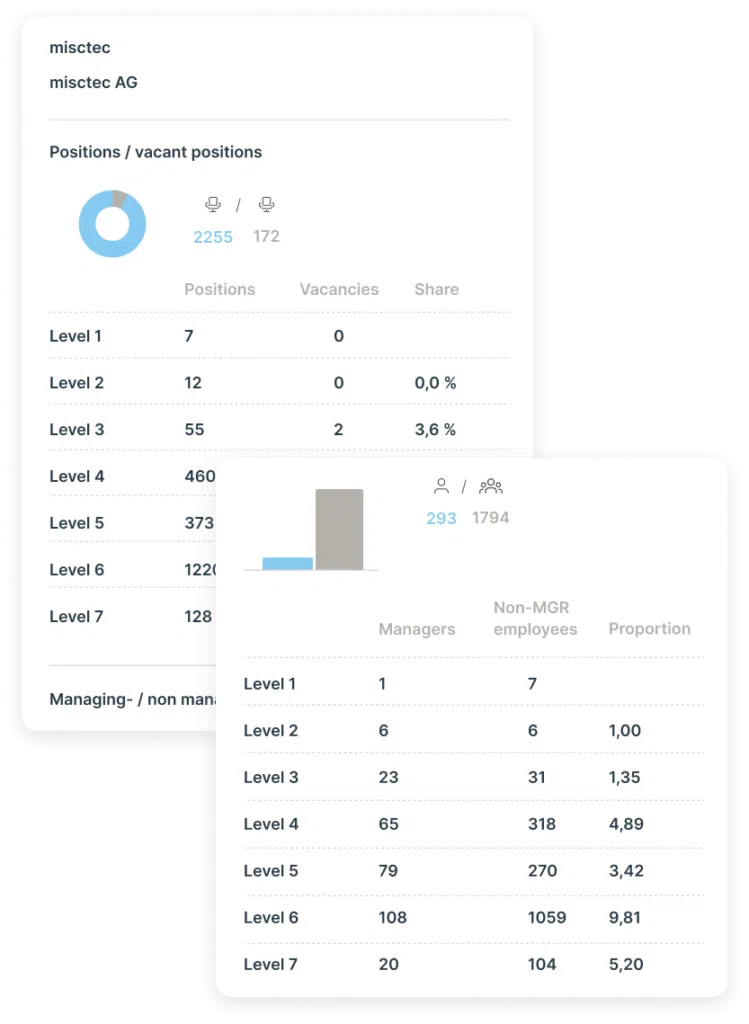
    With Ingentis org.manager, you can visualize and analyze organizational structures, spans of control, staffing levels and workforce metrics. HR teams and managers get early hints of potential overload risks.

    Companies can see, for example:

    • Which areas have persistently high vacancy rates
    • Where spans of control are above average
    • Which teams are growing or shrinking fastest
    • Where workloads are unevenly distributed
    • Which organizational units face a higher risk of overload

    With this, companies can act before a temporary strain turns into lasting staffing, organizational or health consequences.

    Simulate overload risks early with workforce modeling

    Alongside analyzing today’s structures, forward-looking workforce planning matters too.

    With workforce modeling, companies can simulate different future scenarios and assess their impact on capacity and workload.

    You can analyze, for example, what unfilled positions mean for a team, how a planned restructuring affects workloads, or which areas will need more resources if the business keeps growing. Future overload risks become visible early.

    That way, work overload isn’t just detected. It’s prevented at the planning stage.

    Ingentis Use Case Reorganization

    What to do about work overload: measures for companies

    To reduce work overload for good, companies need both individual and organizational measures.

    Proven approaches:

    • Distribute tasks and responsibilities clearly instead of concentrating them informally on committed individuals
    • Review workload regularly and adjust capacity to actual work volumes
    • Build early warning systems, such as employee surveys and metrics on overtime and sick days
    • Train managers to address warning signs early instead of reacting only after absences
    • Question organizational structures regularly to avoid bottlenecks from unbalanced spans of control or staffing
    • Make institutional support easy to find and use, from employee assistance programs to occupational health services

    The sooner overload risks are recognized, the more effectively you can limit the impact on employees and the company.

    FAQ

    The latest posts by Ingentis

    30. October 2026 9 minutes reading time
    Unleash Expo Paris 2026
    UNLEASH Paris 2026
    UNLEASH Paris brought together around 8,500 leaders from 140 countries. AI still dominated the …
    30. September 2026 6 minutes reading time
    Restructuring Shouldn’t Take Three Weeks: What a 15,000-Person Transport Agency Changed
    How a customer of our partner Navigo cut its restructure cycle from weeks to days, and what it says …
    05. August 2026 8 minutes reading time
    Close Up auf das EU Zeichen auf dem 100 Euro Schein
    Why Pay Transparency Starts Now – Not When the Law Comes Into Effect
    Many companies treat pay transparency as a reporting obligation — something to tackle once the …